Speed Swimmer

Beanie’s been having baths once or twice a week because of her skin allergies. She doesn’t really mind them, but sometimes she gets a bit fed up of getting wet. At last week’s swimming lesson she wasn’t keen on having her pre-swim shower so we took a little bit of cooked liver with us to make shower time more enjoyable. It worked a treat – she couldn’t get in there fast enough :)

Normally toys are used to tempt the dogs to do laps of the pool. This doesn’t work too well with Beanie as she’s never been toy oriented…unless of course she’s stealing another dog’s toy to ‘encourage’ it to race her. Today there was a rather noisy dog staying in the kennels next door to the pool and Beanie was more interested in a barking chorus with him than in swimming.

The vet suggested that we try using the liver treats in the pool. What a transformation!! Little Beanie was like a thing possessed. She was just a blur as she did lap after lap, desparately trying to catch that little piece of liver that stayed just ahead of her nose. Normally the vet has to keep hold of her little harness to stop her bolting for dry land. But while she had that little piece of liver in her hand our pup was mesmerised. The only drawback was that she was so focussed on the liver that when she finally got it she’d forget all about swimming and just sink…..with a mouthful of liver and an expression of utter joy on her face.
More Beagle Racing

Today we had another handicap race. A 170 yard race which is great for Beanie as she’s got good stamina. The dogs were all weighed and the lighter dogs were given a 1 yard per pound head start. Beanie is the lightest dog at 22lbs. Murphy (the Derby winner and officially the fastest dog) was the heaviest at 39 lbs (I think that’s 3 lbs lighter than he was at the last handicap race!?).That would have given Beanie a 17 yard head start over Murphy, but Beanie and Murphy didn’t race each other until the final, and in that race we all agreed to ‘race rules’ which meant that the biggest head start a dog can have is 10 yards.

Beanie won the race, which was no surprise to anyone. However, Murphy made up quite a bit of ground – I’m not sure how much but enough to put him in second place.

We were interested to see how Beanie would do if we reversed the handicap. So this time around Murphy had a 10 yard head start over Beanie. Beanie likes to be out in front and we thought she’d run faster if she started from behind. And sure enough, she managed to maintain the distance between her and Murphy this time around. Which meant that she and Murphy were running at pretty much the same speed. Graham suggested a scratch race between Beanie and Murhpy just to see what would happen. Murphy won by less than a dog length.

We’ve noticed a big improvement in Beanie’s speed every week since she started racing. For about three weeks now she’s been getting close to Murphy, but the gap is closing VERY slowly. She’s widening the gap between her and some of the other dogs, but Murphy’s holding on to his lead. We suspect that Murphy is getting fitter and faster every week so our little pup is going to have to work very hard to catch him :)

We also got a little bit of good news with regards to drag hunting. One of the Whippet owners told us about a lady that’s absolutely nuts about hunting with dogs. She’s not too well at the moment, but once she’s better he’s promised to put us in touch with her. Beanie absolutely loves the racing, and we’re sure the sprinting is great for her health (well certainly you can’t beat sprinting for building fitness in people). But as she’s a Beagle we feel that she needs a good bit of long distance running with a pack too. She likes to run with us, but from her point of view you just can’t beat a pack of baying Beagles and something smelly to chase!

Allergy Update & Beanie Does Barf

We got the blood-based allergy test results back from the vet a little while back, and Beanie came out positive for a range of outdoor pollens. Checking those pollens against seasonal tables shows there’s only a window of 3-4 months when none of the allergens are active. Not the best news, especially as all or most of the allergens seem to be common to our local parks.

In truth Beanie’s allergic response isn’t all that bad at the moment. She has itchy spells, but she rarely scratches when she’s really engrossed in play or some food-related activity. Whenever her skin starts to look rashy we wash her with Malaseb shampoo and that prevents any escalation to pyoderma – which would mean a round of antibiotics. The worry of course is that her allergic response may get worse as she gets older, and that the list of allergens she reacts to may grow over time. To counter this, we’re exploring a number of treatments available through the vet, and some alternative approaches too. First, the treatments offered by our vet:

  • Phytopica. This is essentially a Chinese herbal remedy intended to improve the condition of the skin and so reduce itching. It comes in powdered form in little sachets. Beanie gets one of these on her food each day. Results – if any – will take a while to appear, but clinical tests have shown it to be helpful in some cases.
  • Viacutan – this is a very concentrated GLA additive that again is meant to improve the condition of the skin. We’ve been putting a couple of squirts of oil onto Beanie’s kibble once a day for about a month now. I can’t say that it’s reduced her itching noticeably so far, but it’s certainly making Beanie’s coat look fantastic.
  • Immunotherapy. The lab that did the blood tests makes up a coctail of Beanie’s allergens in minute doses and these are injected into her skin. Over time, the doses are gradually increased and the dog’s sensitivity to the allergens is reduced. This treatment is considered harmless in that it works with the dog’s own immune system, and the doses are so low they pale into insignficance compared to the levels she encounters daily on a walk. It is expensive, but Beanie’s insurance should take care of that. We’ve given our vet the go-ahead to order up her first round of treatment from the lab – preparation usually takes a couple of months.

And now for the “alternative” side. Recent research in the human world has linked the rise in allergies to the use of antibiotics:

http://www.sciencedaily.com/releases/2003/10/031001064200.htm

http://www.newscientist.com/article/dn5047-antibiotics-linked-to-huge-rise-in-allergies.html

One of those articles puts forward a theory that it’s the destructive effect of antibiotics on gut bacteria that may be to blame. Correspondingly, one study (don’t have the link to hand at the moment) showed an improvement in human allergy sufferers following a five-month course of daily probiotics e.g. Yakult.

Our little Beanie had more than her fair share of antibiotics in her early months, due in part to us rushing her to the vet whenever she seemed off-color (a bad case of new dog owner anxiety!) We figure that maybe those antibiotics have contributed to her allergies, and equally, maybe if we help to get her gut to return to its pre-antibiotic state her allergies may be reduced. Accordingly Beanie now gets some lactose-free probiotics every day.

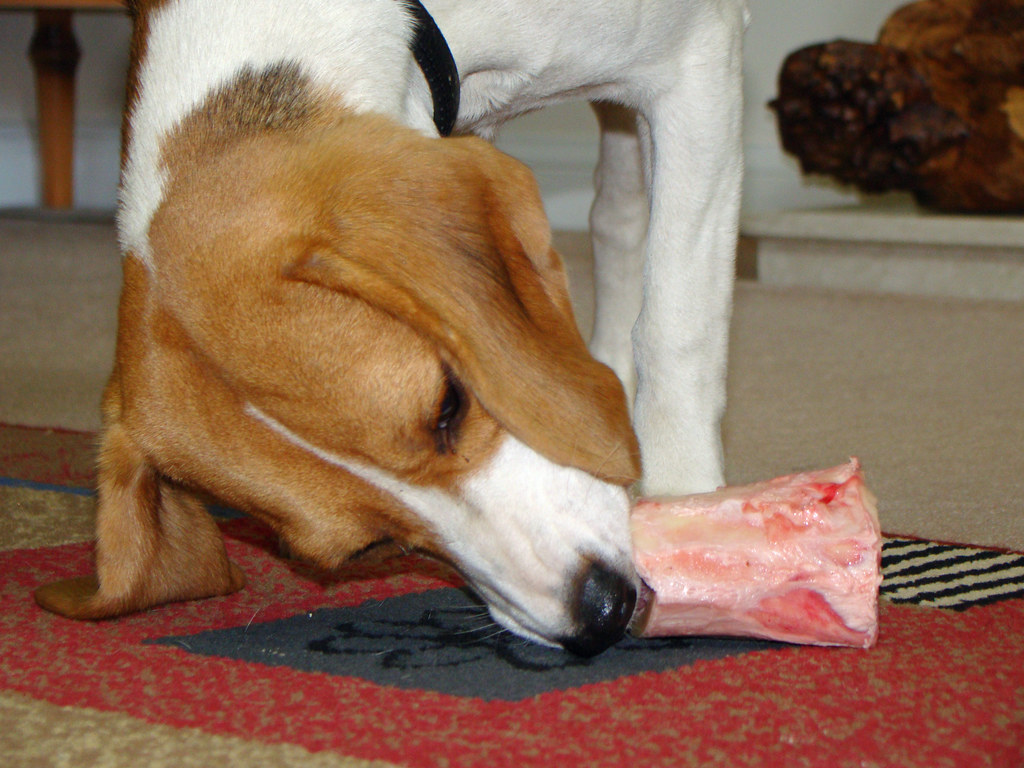
One more thing. We’ve also found references to studies in humans that show that people suffering from allergies frequently have low levels of enzymes. Enzymes are present in raw food, but when food is cooked the body has to manufacture enzymes to help with digestion. This led us to look into raw food diets. Interestingly, we found a lot of claims on forums about the benefits of feeding dogs bones and raw food (B.A.R.F.). Some owners have seen their dog’s allergies all but disappear after switching to BARF. After a lot of research, we’ve now swapped Beanie’s normal dry food at breakfast time for a mixture of raw fish or meat and raw, pureed veg. Every now and then she also gets a fresh bone from the butcher.  At first we went for the conservative option of a marrow bone:

DSC02262

but more recently we got her a lamb’s neck bone. Be thankful I don’t have a photo of that. It was pretty gross. The raw food diet isn’t called BARF without reason. Still, it made Beanie a very happy little dog and she chewed away on her bone for hours without bothering to scratch once.

The raw food diet isn’t without its challenges though. When faced with a new food, Beanie doesn’t immediately know how to tackle it. Susan’s been describing our doglet’s “new breakfast food ritual” to me for a few days now, but this morning I got my lazy bum out of bed early and went downstairs to see it for myself.

The meat portion of this morning’s breakfast was provided by a headless (thank God!) and gutted sardine. The fish’s body lay across the top of the pureed veg (must be pureed to help the dog take in all the nutrients) as I put the bowl down on the lino floor.

Beanie eyed the carcass suspiciously, sniffed it, then carefully ate up all the veg around it. She wouldn’t touch the fish though, oh no! To make things easier, Susan cut the fish into chunks and put the bowl down again. This time Beanie showed more interest, and began picking up the chunks and carrying them away from the easy-to-clean lino floor onto the easy-to-stain light colored carpet (bless her!)

Once she’d arranged the fish pieces to her satisfaction and turned the carpet into a smelly work of modern art, she performed a little taste-test on each chunk in turn. A few minutes later this food obsessed little Beagle – who has eaten real barf deposited by an over-trained jogger in the park, and who can’t walk past a pile of sheep or horse dung without having nibble – decided that human-quality raw sardine was beneath her. Only when Susan eventually gave in and cooked it did she actually eat it!