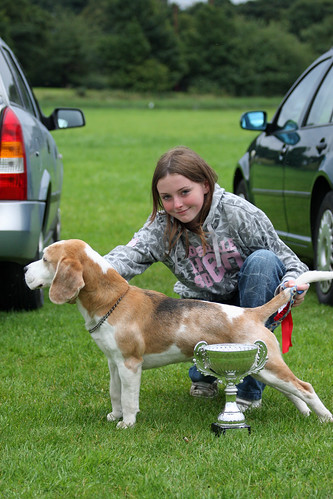
Beanie did most of her growing before 5 months old. Then she very slowly grew upwards until she’d reached 16 inches at around 8 months. Between 8 and 10 months she muscled up a little, but only put on half a pound in weight. In the last three weeks she’s put on 1.5 lbs and her build has changed quite significantly. It’s not fat gain – there have been days when her ribs have started to show at times as she’s actually lost fat in order to build lean mass. She’s eaten an unbelievable volume of food. It just seems that her body has suddenly decided to mature virtually overnight. Her rib cage has expanded and her whole frame is suddenly more solid.
Now it stands to reason that with this very sudden maturity there will be a plateau or even decline in her physical performance whilst her nervous system catches up with her new body. And we have indeed noticed that there has been a leveling and perhaps even a little dip in her physical performance that coincides with the recent growth spurt. Whereas her endurance and speed improved consistently between the ages of 6 and 10 months there has been a definite leveling in the past three weeks and perhaps even a backward slide.
It could well be that his is just natural development – she’s certainly developed as predicted by her vet (albeit more suddenly). But we have little alarm bells ringing simply because the growth spurt and dip in physical performance coincided with a switch to a raw food diet. There is so little scientific research into raw diets so we’re embarking upon this dietary change with more than a little trepidation.
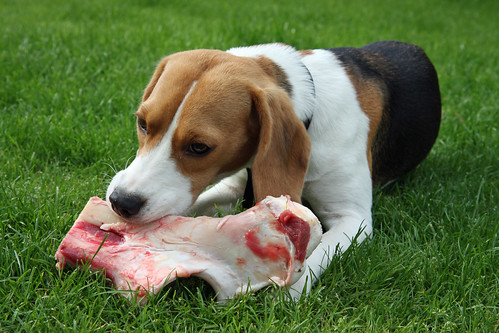
We made the switch primarily because we felt it might help her allergies. We received a lot of dire warnings about the danger of feeding a home prepared diet so we’ve researched it very carefully. And the more we read the more unhappy we are about feeding her kibble. We aren’t yet certain that raw is the way to go though.
OK. The most significant difference in a raw vs kibble diet is that on a kibble diet a dog gets most of it’s energy from carbohydrate. Most kibbles are fairly low protein and low fat. But they’re full of grains or other carbohydrates. I’ve yet to find a study that concludes that carbohydrates are necessary for dogs. I’ve found some studies that claim they are harmful, and I’ve found studies that have proven that working dogs, sled dogs etc do better when they get their energy from fat rather than carbohydrate. Those studies imply that the same would be true of dogs that perform anaerobic activities. Yet I haven’t found a single commercial dog food that doesn’t have quite a substantial percentage of carbs. The (often fanatical) raw feeders claim that the pet food manufacturers only use carbs because they’re cheap. The pet food manufactures and very many vets claim that the only safe way to feed your dog is on a complete commercial diet because it’s vital to get the nutritional balance perfect – only they have the resources to have their diets laboratory tested for balance. Anti-kibble feeders claim that the vets advice can’t be trusted because they get their nutritional training from pet food manufacturers…and they get commission for selling their food. So who to trust?
Now common sense tells me that if young mothers can be sent home with new born babies and trusted to raise healthy adults without a nutritionally balanced, scientifically tested, complete food, then we can learn to do the same for our dog once we’ve learned the basic rules of dog nutrition.
Common sense also tells me that if experts advise humans to eat as wide a range of foods as possible to ensure we get all the right nutrients in our diets then it can’t be good to feed a dog for life on a dried product that contains just a handful of ingredients. In humans experts tell us that they don’t yet know all of the nutrients that we need so the stress the importance of diversity in our diets to increase our chances of a balanced nutrient intake. In humans experts tell us that getting nutrients in artifical form (additives, vitamin pills and powders) doesn’t work. We need to eat foods that contain these nutrients. So why is it different for dogs?
So we’re cautiously moving forwards with the raw. Our vet tells us that all the raw fed dogs that she sees are doing well – although she cautioned us about the fanaticism of many raw feeders.
Anyway, we’ve evaluated Beanie’s diet in light of her recent slow down (which as I’ve said, is quite possible a perfectly normal reaction to a sudden growth spurt). It’s occurred to us that the fat content is far too low given that she no longer has carbs. When choosing meat for her I applied the same rules as I’d apply to us – lean cuts only, skinless chicken breasts and so on. So we’re increasing the fat content of her diet by ensuring that all poultry has the skin on and that we get cheaper, more fatty cuts of meat.
The other big, scary step is we’re going to cut out her kibble entirely – just for a one month trial. (Up until now we’ve been hedging our bets and feeding her raw in the mornings and kibble at night). It occurred to us that it’s probably not good to be forcing her body to get energy from carbohydrates for one half of the day and from fat (or worse still protein) the other half.
We’ll keep you posted! (And of course, if there are any experts on dog nutrition out there we’d love to hear from you).