First Garden Adventure

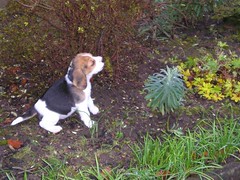
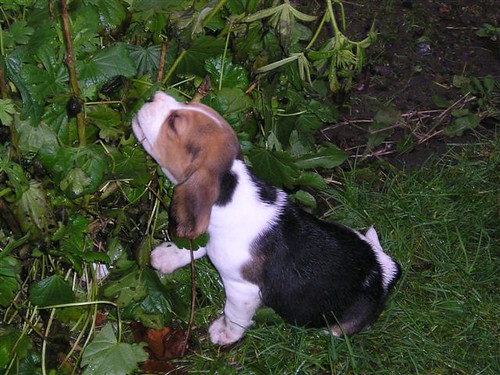
Beanie and the other pups have had their first trip into the breeder’s garden, and she’s sent us a new round of pictures.
pups 029

pups 039

Not surprisingly it looks like a lot of the garden exploration involved chewing. In fact I’ve got a sneaking suspicion that the breeder’s going to need to replace her garden hose:
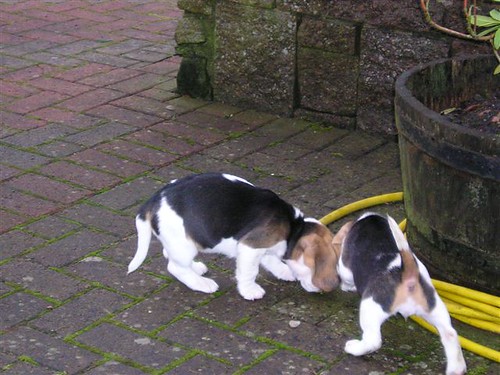
pups 072

In the meantime, we’ve been stocking up on chew toys in the hope that Beanie will chose those over our leather sofa. We’ve got a couple of “Kongs” – hardy rubber toys designed to be loaded with food, and a rubber ball that also acts as a satisfying kibble delivery mechanism. From what I’ve read, it’s a good idea to use such toys for normal feeding, rather than using a typical doggy bowl. Wild dogs apparently spend the majority of their waking hours hunting/scavenging for food. Domestic dogs don’t need to hunt, but handing their food out in a bowl leaves their days very empty, leading to all manner of mischievous behavior (goodbye sofa, plants, shoes, any trailing wires etc.) and excessive dependence on human company.

We’ve also found a couple of puppy training classes nearby. These classes are probably as much about socialization (getting pups to feel comfortable around other dogs, people and children) as they are about training. That makes them pretty much essential, and we’ll definitely be taking Beanie along when we get her.

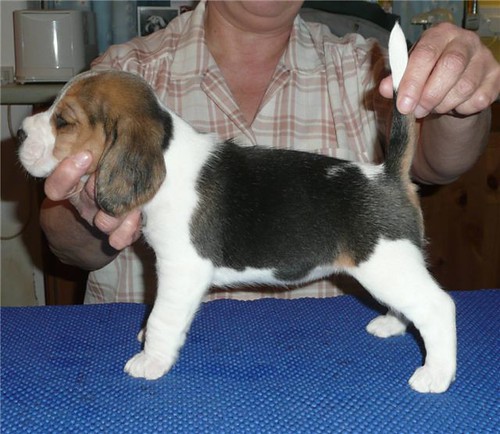
Beanie the Beagle

Over the weekend we received some new photos from the breeder. There were three female pups that hadn’t been picked at that point, and we were asked to say if we had a preference.

Pup #1 was particularly affectionate with everyone she met, but had very sparse markings on her body – she was mostly white. Pup #2 had classic tricolor markings and a sweet face, but was slightly smaller than the rest and was gaining a reputation as an escape artist. Pup #3 also had decent markings and a gentle expression but a rather domed head.

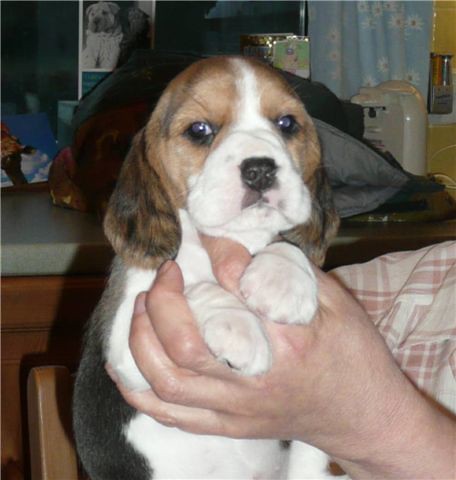
Initially we went for #3 but then spent the rest of the day having second thoughts. And third thoughts. Every time we reviewed the photos our favorite changed. In the end it didn’t matter because the decision was made for us by other people ahead of us in the list: pup number 2 was going to be ours. Here she is:

6a

6d

6e

We drove over to see her today, and the photos don’t come anywhere close to doing her justice! She’s absolutely gorgeous, with a confident, inquisitive and happy nature. It was all pure chance, but I think we got the pick of the bunch. We’ve arranged with the breeder to pick her up just after Christmas – at that point she’ll be about 11 weeks old, and will have had the OK from the vet to explore the outside world. Needless to say, we can’t wait to get her home.

We hung around at the breeders for a good while, holding and stroking our pup, and watching the whole litter at play. It was an amazing thing to see. For about half an hour there was a frenzy of sniffing, chewing, jumping and running around. The fresh newspaper lining their play area was ripped and chewed up in seconds, and the breeder herself was nearly tripped up by a determined assault on her shoelaces. Then quite suddenly the pups ran out of energy and fell asleep in a disorganized heap of paws, bottoms and floppy ears. All except for one particularly vocal youngster that is. He kept going like the Duracell bunny on acid. Whoever gets him is going to have some sleepless nights for a while!

You can see a short video of three of the pups here. Our pup is the one on the left, intently chewing on the legs of a rubber chicken. We’ve called her Beanie – a name that really seems appropriate after seeing her and her siblings jumping about.

Musings on training

With five to six weeks still to go before we pick up our pupster, we’ve been giving serious thought to training. It turns out this is a hot topic. You don’t have to Google for long before you see heated discussions between evangelists for the various approaches. One thing they all seem to agree on though is that consistency is vital – so it’s as well to do your research, pick a method and get the whole family behind it before you get your dog!

Accentuate the Positive

It seems to me that with one controversial exception – which I’ll get to in a moment – most modern methods are based around positive reinforcement. You reward and/or praise your dog whenever it exhibits a desirable behavior, and either correct or ignore it when it does something you don’t like. Over time, the dog learns that doing what you want is the way to go, and you see less and less of the undesirable behaviors like chewing the mail, straining on the leash when walking, and of course that old favorite, humping everything in sight.

A really popular variant of the positive method is “clicker training”. This uses a small gadget that emits a distinctive clicking noise when you press it. You start by getting the dog to associate the clicking sound with something good, like praise or a treat. Once you’ve forged that link, you can then use the clicker as instant signal to the dog that he has done something good. This is apparently superior to simply praising/rewarding the dog because the timing can be very precise, giving the dog a better chance of recognizing that a particular behavior is “good”. If you think about it, that makes a lot of sense. If the good/bad signal is not given close enough to action in question, the dog may not make the right association. There are plenty of clicker training resources on the internet – here are just a couple I found:

http://www.clickerlessons.com/faq2.htm

http://www.clickertraining.com/basics

Crucially, a lot of the “look at my beagle doing tricks” videos on YouTube were achieved using clicker training – see for yourself:

http://www.youtube.com/results?search_query=beagle+clicker+training&search=Search

Leader of the pack

However, there’s a very popular TV show that at first sight seems to be completely at odds with the positive method. That show is Cesar Millan’s The Dog Whisperer. The show is certainly entertaining! Each episode shows hapless owners struggling to cope with their misbehaving and occasionally aggressive mutts. Out of desperation they call in Cesar, and within minutes he gets almost miraculous results.

Cesar’s approach focuses more on the owners than on the dogs. He claims that dogs are pack animals, and that the path to an obedient dog is to turn yourself into the pack leader. You and your family become the dominant ones in the relationship, and once the dog realizes the futility of challenging your leadership, you’ll have a happy, well behaved pet. He rounds up each show with simple tips that sum up his approach, such as “be a pack leader first, and a dog lover second”.

Cesar’s methods seem to have generated very heated discussions. Many claim that recent research completely debunks his theories about the domestic dog being a pack animal like its untamed cousin the wolf. Others point to the fact that you rarely see him praising or rewarding dogs – but you do see lots of physical and verbal correction aimed at dominating the dog, “breaking its spirit”. His fans leap to his defense: he never harms the dogs, the dogs always seem calmer and happier when he leaves, and well, it just plain works.

I found one article that seems to offer a more balanced, open minded assessment of Cesar’s approach, and it makes fascinating reading: http://www.gladwell.com/2006/2006_05_22_a_dog.html

The bottom line seems to be that although Cesar’s theories don’t bear much scrutiny, he is effective because he’s a keen observer of dog and human behavior, and a master of verbal and nonverbal communication. To put it another way, he sees when doggy trouble is brewing and is able to project a calm, assertive mood that quickly nips it in the bud. In that respect, he’s not too different from an equally popular TV dog trainer we had in the UK some time ago: Barbara Woodhouse.

Since beagles have a reputation for intelligence combined with great stubbornness I searched at length to see how his approach would fare with that breed. After all, most of the sources I’ve read say that the positive method is especially applicable to beagles. I found an entertaining blog entry here, fromsomeone who wasn’t a Cesar fan, but was desperate enough to give anything a try. The upshot is that it worked.

So what’s it to be?

For me, a big attraction of the beagle breed is that they tend to be entertaining little characters, and I don’t want to do anything that would spoil that. Equally, it seems that some problems don’t always respond to the purely positive approach. There are times when the dog has to know you mean business!

I think, I hope, it’s possible to blend the two approaches. I plan to use predominantly positive reinforcement via the clicker for the majority of training, but back that up with a calm, assertive attitude so that I don’t present the inconsistent body language or bad vibes that, it seems, are at the root of many dog problems.